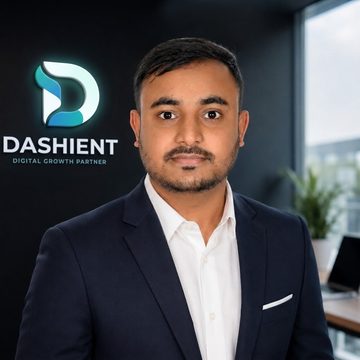
Available for projects, senior roles & PhD research
London · 2026
AshrafHussanBabor
FounderData ScientistResearcherPhD Applicant
Portrait / 01
Founder · Data Scientist · Researcher
I turn complex data into clear decisions — building measurable products, rigorous machine-learning research, and web experiences that make the thinking visible.
Client work & products Data & analytics roles PhD supervisor & funding
Dashient exists to close that gap — connecting spend, behaviour and enquiries so a business owner can see which decisions actually pay for themselves.
Selected work
Three systems, written down properly.
Problem, approach, outcome — the way a case study should read. Every one of these is live software with paying users behind it, not a notebook.
The problem
Owners were spending across Google Ads, Meta, organic search and Google Business Profile with no honest answer to a simple question: which of these actually produced an enquiry?
Approach
Built ingestion jobs against five APIs (Google Ads, GA4, Search Console, Meta, GBP) into a normalised Postgres schema.
Stitched sessions to enquiries on click identifiers and first-party form data, with de-duplication for repeat contacts.
Implemented position-based and last-non-direct attribution side by side in SQL, so the model is inspectable rather than a black box.
What it produces
5
data sources unified
Daily
automated refresh
Per-channel
cost per enquiry
The deliverable is not a chart. It is a defensible number a business owner can act on, with the joins and assumptions written down.
Write a few lines about what you are trying to measure, build or fix. It is read live and matched against the three documented systems on this site — nothing else is invented.
Try an example
The company
I'm building Dashient.
A UK data-led digital growth agency and platform. Pick a channel and watch how a click becomes an attributed business decision.
Marketing Channels
Data Collection
Attribution Layer
Dashboard
Business Decision
Google Ads
Ad click → GA4 & Ads API capture the session → attribution ties it to an enquiry → blended cost-per-enquiry lands on the dashboard → the owner decides where the next £100 goes.
CompanyDashient Ltd · No. 17262776
RegisteredEngland & Wales · ICO-registered
PricingFixed monthly · never a % of ad spend · 3-month minimum
MarketUK trades, hospitality & professional services
Dashient Reporting Dashboard
One screen. Every channel. Real cost per enquiry.
The in-house attribution platform I built — connecting Google Ads, Meta, GA4, Search Console and Google Business Profile into a single source of truth. The demo below lets you drive it yourself.
Interactive demo — try the filters
attribution / overview
Demo environment · illustrative data
Leads
0
Spend
£0
Cost / enquiry
£0.00
Data quality
0.0%
Leads by channel
Spend by channel
Cost per enquiry trend
Conversion trend
Also built · internal platform
Dashient Attendance.
Not everything I build faces clients. Attendance is the internal platform running my own team's clock-ins and payroll — photo & GPS check-in, timezone-anchored shifts and multi-currency, working-days-accurate pay.
attendance.dashient.co.ukDemo
Location captured
Clocked in
08:58 · GMT+1
A. RahmanKitchenClocked in08:58
S. IslamFrontClocked in09:02
M. ChowdhuryKitchenOn break12:30
T. AhmedFrontOff—
Payroll · this month
Base salary£2,000
Working days (22)£2,000
Net payable£0
Pro-rata is calculated on working days, not calendar days, so a mid-month starter is paid for days actually worked. Salary stays at the full working-days amount; weekends count as overtime. Shifts are anchored to each employee's timezone.
FlaskPostgreSQLRailwayGPS check-inMulti-currency
Behind the system
The engineering under the numbers.
Five layers turn five noisy vendor APIs into one honest number. Open a layer.
Layer · Attribution Logic
The core: reconcile sources, credit enquiries across the journey, and surface a blended cost-per-enquiry that survives last-click's blind spots.
Running acquisition across paid and organic — and holding each channel to a cost-per-enquiry.
SEOGoogle AdsMeta AdsGoogle Business Profile
Trajectory
Progression, not a résumé.
Founder & CEO
Dashient Ltd · London, UK · Jun 2026 – Present
Company building · product
Founded and incorporated Dashient Ltd (England & Wales, Co. No. 17262776) and built it into a live digital growth agency for UK service businesses.
Built the Dashient Reporting Dashboard end to end — data pipelines, multi-source API integrations, attribution logic and dashboard UI in Python, Flask and SQL.
Packaged the dashboard with done-for-you SEO and Google/Meta ads under fixed-price monthly plans — every pound of spend tied to real enquiries, not clicks.
Own strategy, product, engineering, pricing and go-to-market; sign off delivery on every account personally.
PythonFlaskSQLREST APIsSaaS
Education & certifications
The credentials behind the work.
Degree
MSc IT with Data Analytics — Distinction
University of the West of Scotland · 2025–2026 · 80.34%
Degree
BSc Computer Science & Engineering
BAUET, Bangladesh · 2019–2023 · CGPA 3.39 / 4.00
Certification
Microsoft Certified: Azure Fundamentals (AZ-900)
Microsoft
In progress
Microsoft Power BI Data Analyst (PL-300)
Exam booked
Course
ITIL v4 Foundation
Introductory course
Research
From comparison to trustworthy AI.
BSc thesis work on deep learning for Bangladeshi coin detection, published at IEEE ICAEEE 2024. I'm now looking for a PhD supervisor and scholarship — UK, EU or remote-friendly — to take the same rigorous, comparative approach into explainable and trustworthy machine learning.
→→→→→
Rigorous accuracy and generalisation comparison across architectures under the same training regime.
Peer-reviewed IEEE conference paper
VGG16, VGG19 and EfficientNetB0 for Bangladeshi coin detection and automated counting — the published output of the BSc thesis.
I am a prospective PhD student actively seeking supervision and funding — not an established academic. Here is the shortest honest version of what I want to work on.
My BSc thesis, published as a peer-reviewed IEEE conference paper, compared deep learning architectures — VGG16, VGG19 and EfficientNetB0 — for Bangladeshi coin detection and automated counting. The work was a complete computer-vision pipeline: dataset construction, augmentation, model training, comparative evaluation and a working counting system. It taught me how to run rigorous, reproducible model comparisons on a real-world recognition problem.
My MSc thesis at the University of the West of Scotland, supervised by Dr Martins Olaleye, moved that same rigour into explainable machine learning: predictive modelling for cardiovascular risk, with SHAP and LIME used to interrogate what the models were actually keying on and whether those explanations held up.
Running Dashient sharpened the same question commercially. Marketing attribution, clinical decision support and computer vision all share a structural problem: a model that cannot justify itself will not be trusted enough to change a decision, and a model that is only accurate on yesterday's distribution is not safe to deploy. I want to spend a PhD on trustworthy machine learning — explanation methods, robustness evaluation and the protocols that tell a practitioner when a model (or its explanation) has stopped being reliable.
What I'm asking for: a supervisor in explainable / trustworthy machine learning or deep learning / computer vision, and a funded route (studentship, scholarship or CDT) — UK, EU or remote-friendly. I am happy to start with a paper collaboration.
Peer-reviewed publication
Deep Learning Techniques for Bangladeshi Coin Detection and Automated Counting System: A Comparative Study of Multiple Algorithms
Comparative study of VGG16, VGG19 and EfficientNetB0 for Bangladeshi coin recognition and automated counting, covering dataset preparation, augmentation, training regimes and performance benchmarking.
@inproceedings{babor_coin_detection_2024,
  author    = {A. H. Babor and others},
  title     = {Deep Learning Techniques for Bangladeshi Coin Detection and Automated Counting System: A Comparative Study of Multiple Algorithms},
  booktitle = {2024 3rd International Conference on Advancement in Electrical and Electronic Engineering (ICAEEE)},
  address   = {Gazipur, Bangladesh},
  year      = {2024},
  pages     = {1--6},
  doi       = {10.1109/ICAEEE62219.2024.10561714},
  note      = {BSc thesis output}
}
MSc thesis
Explainable machine learning for cardiovascular risk prediction: interpreting model behaviour with SHAP and LIME
MSc IT with Data Analytics (Distinction) · University of the West of Scotland · Supervisor: Dr Martins Olaleye
Predictive modelling on clinical risk data with post-hoc explanation methods (SHAP, LIME) used to test which features actually drive predictions and how stable those explanations are — the direct bridge into my proposed PhD topic.
Research interests
Explainable & trustworthy AIComputer vision & deep learningModel comparison & benchmarkingCausal inference for attributionUplift & incrementality modellingModel auditing under distribution shift